Showing posts with label Books Music and Films. Show all posts

Friday, September 2, 2011

Children


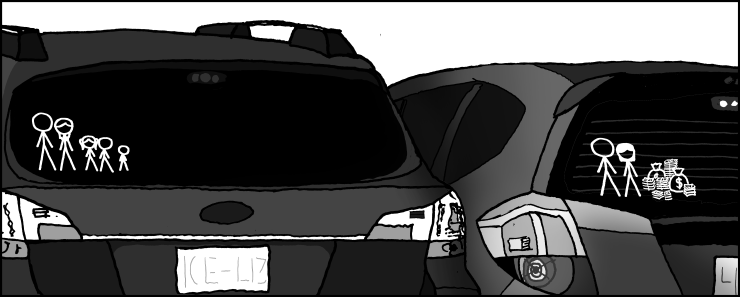
During the past year or so, Bryan Caplan of George Mason University and the Econlog blog has been very visible as a result of his new book "Selfish Reasons to Have More Kids." Based on what I've read about the book, it applies economic thinking to child-rearing and one of the upshots is "it's less expensive and can be more fun than you think." (I've decided I need to read this book, even though my kids are basically in the final stages of growing up and I’ve already had fun.) This clearly connects to some of the early work on economics of family size, why we marry, have children, etc.

But my thoughts were moved to revisiting the issue after seeing this cartoon. I would welcome comments from anyone who has read Bryan's book.

Monday, August 22, 2011

An Enlightend Life


Almost a year ago, I linked to a review of Adam Smith: An Enlightened Life by Nicholas Phillipson. Twice more I linked to other reviews and even added it to my carousel at left as a result of the reviews. I received a copy and added the book to my “to be read” pile – and moved it up as a result of some of the reviews. I finally got to the book this month. I’m only sorry to say I didn’t get to it sooner.

While I’ve read many good biographies of Smith, this one stands near the top.  I don’t say that because it revealed some interesting piece of trivia previously hidden.  Rather my statement is based on the intellectual ground that is covered. This book reveals Smith’s intellectual foundations. It covers familiar ground about Smith’s debt to Hume and the French philosophers and economistes. But it also makes clear Smith’s grounding in his geography and time. Glasgow and Edinburgh had an effect on his world view, politics of England and Scotland social and intellectual climate in which he was raised. As such, much of his work takes on new meaning.

If you would acquaint yourself with the foundation of economics and the mind that helped shape it, I encourage you to consider this book. While not a beach read (it’s getting late for that anyway) the length is not daunting. And if, like me, you like to mark significant passages, you may find yourself stopping frequently to do so.  For this volume offers much to think about and much to learn. Please share your thoughts.

Thursday, July 28, 2011

Debt Rap

Regardless of your politics, this contains lots of trigger words to use in your classes. (HT to Carpe Diem)

Monday, July 25, 2011

That Which Is Not Seen


I know I'm not posting as often as I should. I promise to get on track in the near future. There are a lot of things hanging in the fire right now and, as we all know time is a scarce resource and opportunity cost is an operative concept.

Anyway, James Grant had an excellent article in this this past weekend's edition of The Wall Street Journal. It's about Frederic Bastiat and a new edition of some of his work. I always enjoy what Grant has to say, even when I don't agree with him. Fortunately, I agree with him about Bastiat.  I've added the book to my carousel. Now I just need to find room for it on my growing "to read" pile.

Sunday, June 26, 2011

Examples of Transaction Costs and Inefficiency in Pop Music

I was driving to conference session and was listening some music in my car.  When Runaround by Blues Traveler came on. It occurred to me that the lyrics dealt with an efficient exchange.  The fact that the parties were not trying to minimize the transaction costs, i.e. they were erecting impediments that kept them from reaching an agreement. 

As I thought further, I thought of two more songs (both considerably older) that also dealt with the same issue to some extent.Those were Hello, Goodbye by The Beatles and Let’s Call the Whole Thing Off by George and Ira Gershwin. In both cases, the inability or unwillingness to communicate (transaction costs) is causing a failure of consensus and efficient “exchange.”  None of the songs are perfect, but they may be helpful in setting up the discussion or topping off discussion.  What are your thoughts? Will this work? Does it work?  I know I’m going to try it. I'm also interested if you can think of more recent examples or songs from different genres.

Thursday, June 16, 2011

Out of Poverty: Financial Institutions and Economic Development

Here's a news release (HT to Marginal Revolution) that could be useful a number of ways.  It's about some research that came from data collected by Dr. Robert Townsend of MIT. It the article speaks to the role of saving in helping people out of poverty. But I think it would be useful when discussing financial systems, institutions (the importance of saving), and the formation of capital. There are links to various articles, working papers and a book on Dr. Townsend's page. I'm also adding the book in my carousel at left. I hope to pick up a copy soon. Then I will share my review.

Sunday, May 1, 2011

Economic Concepts Described by Stevie Nicks

Stevie Nicks has a new album coming out titled In Your Dreams and there is an interview with her on Spinner.com. The third question is particularly relevant for this blog. It shows how the concept of specialization works for song-writing. There evidently are benefits from cooperation and division of labor.

Thursday, April 28, 2011

Keynes vs Hayek Rap, Part 2

The second installment of the Keynes vs. Hayek rap video is here courtesy of Russ Roberts and John Papola at George Mason University. For more information, visit Econstories.

Thursday, April 21, 2011

Atlas Shrugged, Some Critics Shrugged, I Didn't


First, let me begin by saying it has been a number of years since I read Atlas Shrugged by Ayn Rand. Consequently, my memory of the details is faded, but I remember the story line.

With that in mind, my wife and I went to see Atlas Shrugged: Part 1 last night. I was aware of the reviews. Many main-stream film-critics have panned it. A few others have given it favorable reviews. But by quantity, the bad exceed the good.  (Quality of review seems to be another issue. I am shocked but not surprised by the vitriol and dismissive attitude that seems to run through many of the negative reviews.)

I would have to say I liked the film. I had no problem with the acting (although the dialogue seemed a bit stiff), and given the nature of the production, I thought the cinematography was up to the story.

I have two criticisms. The first is that the film is not as good as the book. (What film ever is?) My second is the development of the story. Given that this is one of three proposed segments of a film based on a large novel, I walked out feeling glad that I had read the book. I felt too much had been left out. I am hard-pressed to give examples due to amount of time between reading and viewing. But the feeling I had was similar to that when I saw the wide-screen adaptation of the novel Dune. I'm glad I read the book before seeing the film.

My recommendation is the film is worth seeing. If you are true Rand fan or your memory regarding the book is clear you will enjoy it.  If this is your first exposure to Rand, prepare to walk out asking a lot of questions.  But that may be the way Rand would have preferred it. 

I would welcome your comments, particularly if you read the book and saw the film.

Thursday, March 24, 2011

A Matter of Perspective


There is a quote from St. Augustine's City of God comparing governments to robberies. (HT Cafe Hayek) I'm not sure I'm in total agreement, and one may ask whether St. Augustine was just an early libertarian or is quoted out of a larger context. But the parallels drawn in the quote are intriguing. Of particular interest was his recounting of a meeting between Alexander the Great and a pirate who had been brought before him. If true, it would have been an interesting exchange.

Now I'm even more interested in reading Peter Leeson's The Invisible Hook.  I just need to find the time to do so.

Saturday, March 19, 2011

The Triumph of the City

I've run across some interesting reviews, so today's posts are taking a largely bookish turn. The first review I want draw your attention is this one from The Literary Review (HT to Arts & Letters Daily). The book is Triumph of the City: How Our Greatest Invention Makes us Richer, Smarter, Greener, Healthier and Happier by Edward L. Glaeser.

If the review is accurate reflection, Glaeser's book is reminiscent of some of the work by Jane Jacobs. She was also an advocate of the city - as an economic engine for ideas along with many other reasons.

Many of us choose to denigrate urban living and flee to the countryside. Yet it is often the city that provides us the means for what we envision as a more pastoral life that is sought but frequently not found. Despite the poverty that often arises in the megalopolis, people still head to it to find a chance at a better life. This book may have to go on my list of books to be read - I will have to dig deeper to decide whether it should be borrowed or needs to be acquired to gain a place in my library.

On an Enlightened Life


I recently received a copy of Adam Smith: An Enlightened Life, and while I have not yet started reading, this review in the American Conservative (HT Arts & Letter Daily) may have helped me decide where it belongs in my "to-be-read" pile.

I have often told students that those who choose to stereotype Smith as an advocate unbridled greed and enemy of the state need to read him; just as those who label Keynes as an "undercover socialist need to read him.  The two had more in common than many would believe.

This review discusses Smith's distrust of big business and his belief that government had a role to play in a market system. I encourage you to read this review - even if you have a problem with the source. You may choose to read or not read the book as a result of the review. I know my choice.