Here is a link to a Luann comic strip that offers a chance to really explore choices, trade-offs, opportunity cost and even psychic income.
http://www.gocomics.com/luann/2011/11/13
Showing posts with label Wealth and Income. Show all posts
Sunday, November 13, 2011
Monday, September 19, 2011
The Rule of 72
When teaching about interest, it’s always useful to make an aside and familiarize students with the rule of 72. The rule allows for a rough approximation of doubling time once a rate of growth is known. One merely takes 72 and divides it by the rate; the result is a rough estimate of doubling time. Thus something that grows at 4% should take about 18 years to double in size. Something that grows at 6% will take 12 years, etc.
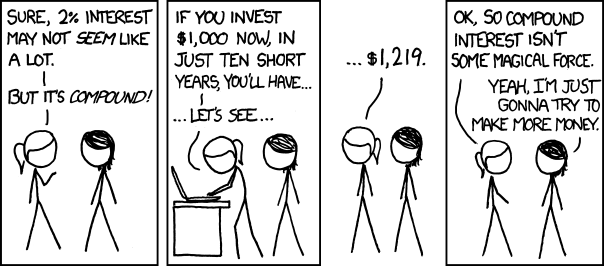
It is usually used when talking about compound interest. I’ve even heard it used when discussing inflation. The power of growth working on growth is impressive, when you start to talk about larger numbers. Conversely, small numbers make you wonder why you should bother, as seen in this XKCD cartoon.
However even smaller numbers, left on their own over long periods of time, can result in truly astronomical sums. Here’s a story from Lapham's Quarterly (HT to Arts & Letters Daily) on that very topic that can be used to wind up class when you have time.
And the government thinks it has troubles with the debt now….
Friday, June 24, 2011
Wealth and Income Effects of Monetary Policy
Back when I worked for the Federal Reserve Bank of Chicago, there were a couple of issues that had to be dealt with repeatedly. One was the limitations of monetary policy – there were certain macroeconomic goals that were easier than others to address through monetary policy. The other was the fact that monetary policy was a broad tool. One could not really initiate policy to affect a narrow sector of the economy – too often it had effects on other areas.
This latter is illustrated well in an opinion piece (free content at time of this writing) from today’s edition of The Wall Street Journal . The piece is critical of the Fed’s monetary policy move referred to as QE2. The charge is that it was meant to have a specific effect on financial markets, but has had unintended consequences in other markets, such as commodities. While I don’t pretend to know whether this is true or not, the piece does explain how QE2 resulted in wealth effects and income effects. And it is there that it provides a service for those of us who teach.
In explaining the linkage between an accommodative monetary policy and prices (of both securities and commodities) it can be used to help students understand the wealth effects (confidence arising from rising stock prices) and income effects (falling real income) that accompany the changing value of the dollar.
You might want to take a look. Let me know if you agree.
Sunday, May 8, 2011
The Value of Cutting Costs
Recently, I took an online course that focused on economic development and poverty. One of the discussions we had questioned whether technological innovation benefited the rich, the poor or both. One of the conclusions was that, because of the cost of innovation, initial benefits tended to gravitate to the rich because they could pay a price that would compensate the producer. But over time, as the cost structure changed, the benefits were realized by those at lower income levels, as well. One of our classmates even noted that, because of the passage of time, the technology was actually better quality as well as cheaper by the time it became available at lower prices.
Yesterday, there was an opinion piece in The Wall Street Journal that dealt with that topic. It reinforces the point that the real value in innovation may not come in the initial stages - many innovations don't last very long. But for new products and technology that does last, the real benefit comes as producers find ways to reduce the cost. And I will add, improve the quality and reliability in the process.
This relates to my post from one week ago which linked to a discussion of poverty and choice. It also reminds me of a quote from Joseph Schumpeter who once said "The capitalist engine is first and last an engine of mass production which unavoidably also means production for the masses. . . . It is the cheap cloth, the cheap cotton and rayon fabric, boots, motorcars and so on that are the typical achievements of capitalist production, and not as a rule improvements that would mean much to the rich man. Queen Elizabeth owned silk stockings. The capitalist achievement does not typically consist in providing more silk stockings for queens but in bringing them within reach of factory girls."
I welcome your thoughts.
Sunday, May 1, 2011
Choice in Poverty?
There is a very thought-provoking article in the new issue of Foreign Policy. (HT to EconomicsandEthics) The article examines recent research on food and poverty in much of the developing world and comes to some conclusions that are sure to stir up debate in development circles.
But there are some fundamental applications that you may want to consider. The article offers numerous examples of choices people make that many would consider questionable, especially when faced with poor diet. But the discussion of opportunity cost that can result from these examples may broaden your students' perspective of the concept.
There are also examples of inferior goods that can readily be used. Please share your thoughts.
But there are some fundamental applications that you may want to consider. The article offers numerous examples of choices people make that many would consider questionable, especially when faced with poor diet. But the discussion of opportunity cost that can result from these examples may broaden your students' perspective of the concept.
There are also examples of inferior goods that can readily be used. Please share your thoughts.
Friday, March 25, 2011
Human Capital and Growth
If you're looking for an example of the role of human capital on growth and the production function, look no farther than this article from today's edition of The Wall Street Journal. (Subscriber content at this writing but put the story title in your browser and you should be able to find an ungated version.) The story is about Portugal and the low level of education in that country. As you would expect, it has a significant impact on growth and standard of living.
The video below is from the story and explains some of the institutional aspects of the problem. And as we understand, you can change the law but changing culture and tradition can take a while.
I think this would make a great example for that production function discussion. Please share your thoughts.
The video below is from the story and explains some of the institutional aspects of the problem. And as we understand, you can change the law but changing culture and tradition can take a while.
I think this would make a great example for that production function discussion. Please share your thoughts.
Thursday, February 10, 2011
Beef...It's What's for Dinner...and So Much More
Some of you may remember the tag-line spoken by Robert Mitchum in a long series of commercials. But look at this article in today's edition of The Wall Street Journal (subscriber content at this writing - but put the article title in your browser and you may find an ungated version). The slideshow alone is very helpful and that is open access.
According to the article, beef is a normal good; an indicator of rising prosperity and economic growth; and a subject of globalization.
I think you'll find it interesting and I hope you find it useful.
Wednesday, February 2, 2011
Comparatively Rich?
This past weekend, The New York Times reviewed a book titled The Haves and the Have Nots: A Brief and Idiosyncratic History of Global Inequality
.The book is about income distribution and while it may sound like the same old argument about the inequality of it all, it is more. The book is built around three academic essays; but each is followed by a number of short pieces to add flavor and color to the discussion.
What is particularly interesting to me is the information that seems to be in the second and third essays - those that focus on global inequality. There are bits of information in there that can be used with students when discussion income inequality and economic development that might bring clarity to their thought. Specifically, it will help them understand that the idea of wealth can be somewhat subjective.
This blog post from The New York Times (HT to Marginal Revolution) was a follow-up to the review. The author points out an interesting chart that shows that the average real income of the bottom five percent in the U.S. is higher than the average real income of the top five percent in India.
Having said that, I suspect the spread in India's top five is significantly larger than the spread in the bottom five in the U.S. That alone should help students become more skeptical about how "averages" are used. But the relative wealth of the "poor" in the U.S. is something that we often forget. That does not excuse the gap, but it does put it into a different perspective. I hope to read this book soon, and I'm placing it on my carousel at left. I hope some of you are also moved to read it, and come back and comment.
Wednesday, December 8, 2010
Measures of Growth
This can be filed under "old news" for some of you, but for others it may be helpful information. Hans Rosling, who developed Gapminder, has a new presentation linking economic growth to health over 200 years. (HT to Mark Perry because his blog is where I ran into it first. Since then I've seen it many times, many blogs.) When you talk about measures of progress in the early part of your macro classes, you might want to offer this as a way of explaining how economic progress affects in social progress. It also offers an entre for discussion of coincidence, correlation and causation. Regardless of how or even if you use this presentation, imagine a not too distant future when you can do something like this in your classroom.
Monday, October 4, 2010
Why Economic Education
The answer lies in this article from today's edition of The Wall Street Journal. It seems that as high unemployment lingers in this period of slow growth, people are becoming increasingly skeptical about the benefits of trade. And the skepticism cuts across all job, income and party affiliation brackets.
People are increasingly unaware of or unconvinced about the benefits of trade. They appear to be more concerned about job security than the corresponding impact on prices. In fact, I am reminded of a line from the musical play 1776
. At a critical point of the debate, John Dickinson, a delegate from Pennsylvania, is reminded by his fellow delegate, Ben Franklin, that those who would sacrifice freedom for a little security can end up losing both. In the play, Franklin speaks of political freedom. But the same can be said for economic freedom. By sacrificing the freedom to trade to gain job security, we may sacrifice the benefits of competition that come with trade, and face a reduced number of jobs in the long-run.
This brings me to a related opinion piece in today's Journal. In it, the author uses a doomsday clock analogy to argue for renewing the Bush tax cuts and moving forward on free trade. I'm not about to discuss the tax cuts in this post. But his discussion about trade agreements is relevant. He likens the increasing calls for protectionism in various guises to the Smoot-Hawley Tariff that was a contributing factor to the Great Depression.
The analogy is not quite perfect, but the result could be. By cutting trade, we stand not only to face higher consumer prices, but to put ourselves at a disadvantage as world markets pull out of the slowdown and kick into high gear. If the U.S. isolates itself from the growing world market, we shouldn't be surprised if potential customers shop elsewhere.
So this brings us back to the topic of today's post. As economic educators, we need to be sure that students understand all sides of the trade issue. There are not just costs of trade, but benefits from trade. And the benefits can have long-term implications. I'd welcome your thoughts.
People are increasingly unaware of or unconvinced about the benefits of trade. They appear to be more concerned about job security than the corresponding impact on prices. In fact, I am reminded of a line from the musical play 1776
This brings me to a related opinion piece in today's Journal. In it, the author uses a doomsday clock analogy to argue for renewing the Bush tax cuts and moving forward on free trade. I'm not about to discuss the tax cuts in this post. But his discussion about trade agreements is relevant. He likens the increasing calls for protectionism in various guises to the Smoot-Hawley Tariff that was a contributing factor to the Great Depression.
The analogy is not quite perfect, but the result could be. By cutting trade, we stand not only to face higher consumer prices, but to put ourselves at a disadvantage as world markets pull out of the slowdown and kick into high gear. If the U.S. isolates itself from the growing world market, we shouldn't be surprised if potential customers shop elsewhere.
So this brings us back to the topic of today's post. As economic educators, we need to be sure that students understand all sides of the trade issue. There are not just costs of trade, but benefits from trade. And the benefits can have long-term implications. I'd welcome your thoughts.
Thursday, July 29, 2010
Conditional Cash Transfers
The new edition of The Economist contains a pair of articles that are worth your time. (You can find them here and here.) They're short and they address issues of incentives, income distribution, productive resources and economic development.
The focus of the articles is a relatively new idea in economic development programs, conditional cash transfers (or CCTs). The idea is that the poor are paid for certain activities: getting their children vaccinated or making sure their children are in school. It appears to be successful in many areas, although it is more successful in rural areas than in urban areas.
While I'm not sure to what extent you address economic development (that's an "end-of-the-course" topic that too frequently gets left out, either for lack of time, lack of interest, or lack of understanding); I do suspect you discuss incentives, and possibly income distribution or productive resources. I would be interested in your assessment of these articles.
The focus of the articles is a relatively new idea in economic development programs, conditional cash transfers (or CCTs). The idea is that the poor are paid for certain activities: getting their children vaccinated or making sure their children are in school. It appears to be successful in many areas, although it is more successful in rural areas than in urban areas.
While I'm not sure to what extent you address economic development (that's an "end-of-the-course" topic that too frequently gets left out, either for lack of time, lack of interest, or lack of understanding); I do suspect you discuss incentives, and possibly income distribution or productive resources. I would be interested in your assessment of these articles.
Monday, July 12, 2010
Debt Issues...Micro and Macro
I've been busy with my online courses and I hope to get busier.
Nevertheless, here is a comic that, in my opinion, offers all kinds of possibilities as a discussion starter.

The first and third panels carry the weight.
The first panel can be related to expectations, the business cycle, and employment. (For those of you unfamiliar with the strip, Gene is the soon-to-graduate college age son of the couple you see.)
The third panel can be used to illustrate credit, debt & deficits, normative statements, business cycle, animal spirits, expectations, and behavioral economics. And those just hit me in the first minute. Do you see other possibilities? If so, please share.
Nevertheless, here is a comic that, in my opinion, offers all kinds of possibilities as a discussion starter.
The first and third panels carry the weight.
The first panel can be related to expectations, the business cycle, and employment. (For those of you unfamiliar with the strip, Gene is the soon-to-graduate college age son of the couple you see.)
The third panel can be used to illustrate credit, debt & deficits, normative statements, business cycle, animal spirits, expectations, and behavioral economics. And those just hit me in the first minute. Do you see other possibilities? If so, please share.
Wednesday, June 30, 2010
How We Save Money
For those of you teaching personal finance, here is an engaging graphic from VisualEconomics that shows how Americans choose to save money. I think it lends itself, not only to discussions about saving, but about to risk/reward and opportunity cost.
What do you think?
What do you think?
Friday, June 18, 2010
Birthday of Franco Modigliani
Modigliani may not be someone you're familiar with. But he won the 1985 Nobel Prize for Economics, along with Merton Miller. He was a co developer of what would come to be called the Modigliani-Miller theorem of corporate finance which states that under some circumstances, the debt-to-equity ratio of a firm (the amount of borrowed money vs. owner equity used to finance the firm) does not really matter.
While that may not be high on your list, this next item for which he was recognized is. If you teach personal finance or economics, you undoubtedly have heard of the life-cycle hypothesis. This states that because most people want their consumption level to be relatively smooth, they tend to save in high income years and to spend (dissave) in low income years (like retirement). That's something you probably use. And if you don't you might want to consider using it.
If you're interested in learning more about Modigliani, I would suggest here and here.
While that may not be high on your list, this next item for which he was recognized is. If you teach personal finance or economics, you undoubtedly have heard of the life-cycle hypothesis. This states that because most people want their consumption level to be relatively smooth, they tend to save in high income years and to spend (dissave) in low income years (like retirement). That's something you probably use. And if you don't you might want to consider using it.
If you're interested in learning more about Modigliani, I would suggest here and here.
I'm Not Sure This Is the Answer to the Resource Curse
A couple of days ago, I wrote about "the resource curse", referencing an article in the Planet Money web site. As a follow up, here's another story on NPR's Planet Money about a proposal by some economists to distribute the proceeds and break the resource curse.
I don't think it would solve the problem of the curse. It removes the incentive for the people to develop anything new. They have a steady stream of income (at a level that may well be above what they have now), and it comes in without any real effort on their part. It may remove the government as the funnel for the funds, but it doesn't create any incentive to diversify.
Thursday, June 17, 2010
Follow Up to Haitian Rice Farmers
A few days ago, I posted on the unintended consequences of aid to Haiti and the impact it was having on that nation's rice farmers. Here's a follow-up from National Public Radio's Planet Money.
Wednesday, June 16, 2010
Economics of the World Cup
While I know most of you are out of school, you may still be looking for interesting graphics to use during the forthcoming school year.
If you have soccer players, coach soccer, or like soccer, here is a very good graphic courtesy of The Mint. It shows some of the economics of the World Cup. This could be especially useful when discussing the economics of big events or sports facilities. One could even dig further by researching the economics of previous World Cups or Olympics. (One of my students said he had heard a story that the Athens Olympics was one reason Greece was in the condition it is in. We had a good, short discussion on whether or not that might be true.)
***UPDATE***
Here is a link (free access at this writing) to a story in today's (6/17/10) edition of The Wall Street Journal that seems to confirm my student's comment.
If you have soccer players, coach soccer, or like soccer, here is a very good graphic courtesy of The Mint. It shows some of the economics of the World Cup. This could be especially useful when discussing the economics of big events or sports facilities. One could even dig further by researching the economics of previous World Cups or Olympics. (One of my students said he had heard a story that the Athens Olympics was one reason Greece was in the condition it is in. We had a good, short discussion on whether or not that might be true.)
***UPDATE***
Here is a link (free access at this writing) to a story in today's (6/17/10) edition of The Wall Street Journal that seems to confirm my student's comment.
Afghanistan and the Resource Curse
When discussing economic development, the folks at National Public Radio have an interesting story to use with students in a discussion of "the resource curse." Most often we use that concept to refer to economies that are blessed with abundant natural resources but fail to diversify. Those economies frequently see the natural resources as a way to improve the lives of the people, but it only works if other resources are developed, as well.
You can also use this in discussions about the production function. One can put the equation (Y = A f (L, K, H, N)) on the board and begin by asking what the story means for Afghanistan. You can then extend by asking about the other factors and how they can be provided. And wrap up by asking about what happens if the only resource that is developed is N?
Monday, June 14, 2010
Standard of Living
One of my favorite exercises is explaining real income and improving per capita gdp. The Federal Reserve Bank of Dallas had some great tables in their annual reports in the 1990s. They showed how the real cost of many common items fell as a result of improving productivity and how standard of living related to labor costs.
Now, there's another resource you can use. Check out this post by David Henderson on EconLib. It links to Radio Shack catalogs from 1939 to 2005. It's a little more up-to-date. And while it is limited to electronic gadgets, it still makes the point.
I'd be interested in your thoughts.
Now, there's another resource you can use. Check out this post by David Henderson on EconLib. It links to Radio Shack catalogs from 1939 to 2005. It's a little more up-to-date. And while it is limited to electronic gadgets, it still makes the point.
I'd be interested in your thoughts.
Wednesday, June 9, 2010
Institutions, Choices and Structure: An Interview with Richard Florida
There is a very interesting interview at BigThink featuring Richard Florida.
Florida is Director of the Martin Prosperity Institute at the University of Toronto and is a widely-respected author. And while I have not yet had time to watch the entire interview, his section on The End of Home Ownership was interesting and raised a few questions for me.
To what extent is the structure of the U.S. economy the result of institutional choices to promote home ownership? I think one could make a strong case that the urban/suburban structure that dominates many parts of the U.S. is a result of our belief in the value of property (not just monetary value) and the formalization of that belief in ways that we tax real estate (what's deductible, exempt, etc.).
I even find Florida's view of urban centers and why people choose to live in them reminiscent of the work of Jane Jacobs, who I've blogged on before. I'd be interested the thoughts of others. To what extent do you think the institutions shape our choices and, by implication, shape our perceived opportunity cost? I'm especially interested in the question posed by one of Florida's students - "what is the American Dream? Economic opportunity or home ownership? Are they exclusive? Or do they overlap?
I'm not sure how I would use this in class, but it is a stimulating idea for discussion.
Florida is Director of the Martin Prosperity Institute at the University of Toronto and is a widely-respected author. And while I have not yet had time to watch the entire interview, his section on The End of Home Ownership was interesting and raised a few questions for me.
To what extent is the structure of the U.S. economy the result of institutional choices to promote home ownership? I think one could make a strong case that the urban/suburban structure that dominates many parts of the U.S. is a result of our belief in the value of property (not just monetary value) and the formalization of that belief in ways that we tax real estate (what's deductible, exempt, etc.).
I even find Florida's view of urban centers and why people choose to live in them reminiscent of the work of Jane Jacobs, who I've blogged on before. I'd be interested the thoughts of others. To what extent do you think the institutions shape our choices and, by implication, shape our perceived opportunity cost? I'm especially interested in the question posed by one of Florida's students - "what is the American Dream? Economic opportunity or home ownership? Are they exclusive? Or do they overlap?
I'm not sure how I would use this in class, but it is a stimulating idea for discussion.
Subscribe to:
Posts (Atom)