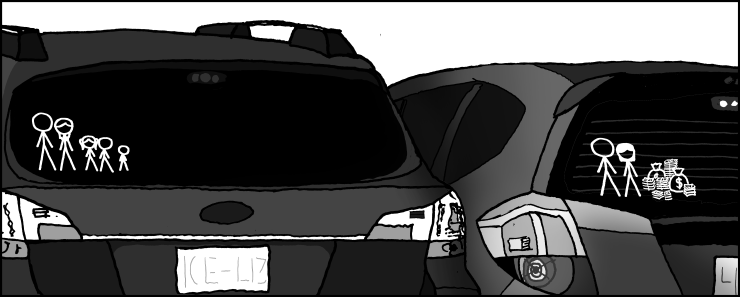
Courtesy of Wondermark.
http://wondermark.com/842/
Showing posts with label Choice and Opportunity Cost. Show all posts
Showing posts with label Choice and Opportunity Cost. Show all posts
Friday, June 1, 2012


Friday, February 3, 2012
Economic Systems and Institutions
First, I know it's been a long time between posts - life isn't always what we want. I frequently come across items that should be brought to your attention. But due to other factors, I have to choose. It seems opportunity cost is an operative concept.
I don't know how many of you spend time discussing economic institutions and systems. While many textbooks seem to bypass the subject or give it short shrift, I always try to spend at least one class period discussing them. And they are revisited throughout the semester. The rules that a society puts in place to influence or control decision-making are important if we are to understand the decisions.
Here is an excellent article from The Daily (HT to Arts & Letters Daily) that really brings the importance of institutions home. What I find particularly interesting is the aspect of traditional economies in a modern setting. One quickly understands how traditions can be an important mold for many choices. And attempts to change the rules, by issuing formal rules to replace informal rules, can have significant costs on many levels. I hope you take a moment to check the article out. And I hope you will share your thoughts.
Wednesday, January 18, 2012
Honey...I May Have Shrunk the Economy
Actor/writer Rick Moranis has a very amusing piece in the opinion section of today's edition of The Wall Street Journal. What struck me was how good it would be in setting up a discussion of opportunity cost. It really harkened back to Bastiat's "that which is seen and that which is unseen." I strongly recommend it and I hope you comment with your opinion.
Thursday, November 24, 2011
The Invisible Hand and Thanksgiving
I suspect many of you are busy today. Our family had our dinner yesterday because one of my sons is working on Thanksgiving Day. But when you get a chance, you might want to review this column by Jeff Jacoby of The Boston Globe. (HT to Carpe Diem for the reminder.)
The market works wonders. And if you're thinking "but turkey was relatively expensive this year"; the market explains that, as well. Here's an item from Bloomberg.
Happy Thanksgiving.
The market works wonders. And if you're thinking "but turkey was relatively expensive this year"; the market explains that, as well. Here's an item from Bloomberg.
Happy Thanksgiving.
Tuesday, November 22, 2011
Putting Things in Perspective ... Thanksgiving Edition
As we approach year's end and the traditional holiday season, and with the failure of the Supercommittee to achieve anything of substance beyond finger-pointing, here is something courtesy of XKCD to fill those odd classroom moments.
Sunday, November 13, 2011
Happiness Can Make You Miserable
Here is a link to a Luann comic strip that offers a chance to really explore choices, trade-offs, opportunity cost and even psychic income.

http://www.gocomics.com/luann/2011/11/13

http://www.gocomics.com/luann/2011/11/13
Wednesday, October 26, 2011
Voting, Externalities and an "Invisible" Hand?
I've been too busy lately. I've found some time to read, but precious little to blog. So this is about a week overdue. This article (HT to Marginal Revolution) is really a wealth of opportunity. You can connect all kinds of economic concepts to voting. The author makes some excellent arguments for voting and not voting. It is the latter that are most intriguing. In some instances, the author seems to be relying on normative judgments about what is a good policy. In other instances, the argument of common good runs up against rational self-interest.
Do you agree with the author?
Tuesday, October 4, 2011
Wednesday, September 21, 2011
Markets
Russ Roberts at Cafe Hayek has generously made an essay available. It is a visual explanation of how markets use knowledge. For those of you teaching AP Micro or Principles courses, this will be very handy. For those of you teaching more traditional courses or who feel it might be beyond student reading ability, it might be good background for you to integrate into your lesson. Either way, it is worth your time.
Friday, September 2, 2011
Children
During the past year or so, Bryan Caplan of George Mason University and the Econlog blog has been very visible as a result of his new book "Selfish Reasons to Have More Kids ." Based on what I've read about the book, it applies economic thinking to child-rearing and one of the upshots is "it's less expensive and can be more fun than you think." (I've decided I need to read this book, even though my kids are basically in the final stages of growing up and I’ve already had fun.) This clearly connects to some of the early work on economics of family size, why we marry, have children, etc.
." Based on what I've read about the book, it applies economic thinking to child-rearing and one of the upshots is "it's less expensive and can be more fun than you think." (I've decided I need to read this book, even though my kids are basically in the final stages of growing up and I’ve already had fun.) This clearly connects to some of the early work on economics of family size, why we marry, have children, etc.But my thoughts were moved to revisiting the issue after seeing this cartoon. I would welcome comments from anyone who has read Bryan's book.
Monday, August 29, 2011
Something You Can Use the First Day
For those of you who have been gone all summer, I haven't been particularly prolific - too busy. But there are some very usable resources in the archive so you might want to spend some time back-tracking. Regardless, welcome back.
For those of you who are just starting school or haven't started yet, here's something to use on day one.

Sunday, August 21, 2011
Choice: Is Decision Fatigue Worth Talking About? (Your Choice)
I suspect most of us don't go very far into the decision-making process. After all, most of us are teaching a specific curriculum and time is a scarce resource. We have to choose.
We probably discuss why we have to make choices and perhaps we introduce a decision-making model. But unless we're really into behavioral economics or we're enamored by categorizing people into optimizers or satisficers, we probably don't go much further. That's okay. Nevertheless, here's a recent article from The New York Times that discusses something called decision fatigue.
The research highlighted in the article looks at the types of decisions we make when we have to make a lot of decisions. The results may not be of much immediate use in our classroom. But students often ask why we don't always make rational decisions. I think the article goes well with this TED Talk on The Paradox of Choice with Barry Schwartz.
It may be something for an extra credit assignment. What do you think?
Friday, May 13, 2011
Decisions, Choices and Opportunity Costs
Here is an example of a "non-economic" choice that is just full of potential for opportunity cost. (We will overlook the fact that they both say "price" when it's really "cost" they're talking about.)

Wednesday, May 4, 2011
Opportunity Costs & Trade-Offs
The Corps of Engineers’ demolition of a levee to relieve pressure and save the town of Cairo, Illinois but at the expense of farmers in Mississippi County, Missouri offers some great possibilities to review some of the most basic concepts. You can find The Wall Street Journal's version here with a slide-show, video and interactive graphics. But you can also find the story just about anywhere on most news sites.
According to the stories, there was a choice to be made. If nothing was done, the water could break through the levee at Cairo and put much of the town under 20+ feet of water. Or the Corps could blow a hole in the levee on the Missouri side of the River. This would save the town but flood farmland, farmland that was already planted.
One can examine the potential for economic losses (damage and lost business in the city vs. damage and lost crop revenue), but there are additional questions. What about the impact on commodity prices? These prices are already climbing. One story I heard hinted that the planted crops are a total loss and after the flood waters recede and the fields dry out it may be too late to plant a second crop? And there are now stories about the farmers being eligible for disaster relief. How does the relief to the farmers compare to the relief payments that would be made to the residents of Cairo? Would any of these qualify as “unintended consequences”? My inclination would be to say “yes” regarding the impact on commodity prices, but “no” to the disaster relief question.
What about political questions? How many voters would be affected on the Illinois side vs. the number of voters affected on the Missouri side? I don’t want to believe that was part of the calculation, but it does spring to mind.
Anyway, leaving the political issue out of the question, how do you see this story being used in the classroom, if at all?
Sunday, May 1, 2011
Choice in Poverty?
There is a very thought-provoking article in the new issue of Foreign Policy. (HT to EconomicsandEthics) The article examines recent research on food and poverty in much of the developing world and comes to some conclusions that are sure to stir up debate in development circles.
But there are some fundamental applications that you may want to consider. The article offers numerous examples of choices people make that many would consider questionable, especially when faced with poor diet. But the discussion of opportunity cost that can result from these examples may broaden your students' perspective of the concept.
There are also examples of inferior goods that can readily be used. Please share your thoughts.
But there are some fundamental applications that you may want to consider. The article offers numerous examples of choices people make that many would consider questionable, especially when faced with poor diet. But the discussion of opportunity cost that can result from these examples may broaden your students' perspective of the concept.
There are also examples of inferior goods that can readily be used. Please share your thoughts.
Wednesday, April 20, 2011
Conservation as Conspicuous Consumption
Yesterday, I heard a very interesting interview on Marketplace, the public radio program. The interview was with Stephen Dubner, coauthor of Freakonomics and host of Freakonomics Radio. Dubner talked about the idea of conspicuous conservation.
and host of Freakonomics Radio. Dubner talked about the idea of conspicuous conservation. Now you probably know about conspicuous consumption. The phrase was coined by Thorstein Veblen who stated that one reason we spend money can be to show off our wealth. Basically what we buy can signal our wealth to others and can, presumably, have an effect on our status or how others view us.
I often ask my students why they buy certain brands of clothes, etc. when other cheaper brands would provide the same function. This leads to a discussion of utility and an understanding that many people place a high value on the perceived ability of certain products to impress other people.
This brings us back to the interview. As I said, Dubner was talking about conspicuous conservation - how certain people will buy certain things to show how "green" they are, and he cites some research by a pair of economists that indicates the payoff for making these choices can be quite high in certain communities. In essence, the purchasers may be willing to pay a higher price in order to secure higher prestige in a given community. This offers a great opportunity to discuss value and utility. Because certain choices may not necessarily be the best in terms of actual effect, but may have a higher value as "conspicuous conservation/consumption." Let me know what you think of the interview.
Monday, April 18, 2011
I'm Back
And before you say "were you gone?", a combination of a family funeral, a round of the flu, a secondary respiratory infection and end of term for one of my on-line courses have made things a bit busy here. I'm still recovering but I'm feeling better. Nevertheless, I thought I would start out slow...
Here are a couple cartoons (HT to Economics and Ethics) to use in your class. The first is a classic example of how constantly chasing efficiency can create its own trade-offs.

And this link will take to you an illustration from The Washington Post that could prove very useful when explaining the risk/return concept.
I'll try to get back in the swing of things during this week.
Here are a couple cartoons (HT to Economics and Ethics) to use in your class. The first is a classic example of how constantly chasing efficiency can create its own trade-offs.
And this link will take to you an illustration from The Washington Post that could prove very useful when explaining the risk/return concept.
I'll try to get back in the swing of things during this week.
Tuesday, March 29, 2011
Risk-Pricing, Adverse Selection and Moral Hazard
There's an entertaining article in today's edition of The Wall Street Journal that has all kinds of possibilities for the classroom. The article is about subway riders in Scandinavia who ride for free. Instead of buying tickets, they contribute to a pool that pays their fines if they get caught. They've set up a kind of "insurance" pool.
But if we think about it, we have an excellent example of adverse selection. I suspect the only ones who are paying into the pool are those who have no intention of purchasing a ticket and thus know they run the risk of being caught. Once a person has purchased the "insurance", they will likely be even less inclined to pay a fare.
So what keeps the premium from being the same as the amount of the fine? It's the likelihood or risk of being caught. If chances were 100% that you would be caught and fined, the pool would have charge a premium equal to the fine. This scheme can only work as long as enforcement by the authorities is lax enough to keep the premium less than the fare. Once the risk rises to the point where the premium costs more than the fare, it is cheaper to buy the ticket.
There is much more to this issue, as you'll see when you read the article. I'm sure you will see more possibilities. I did. But I hope you will share your ideas.
But if we think about it, we have an excellent example of adverse selection. I suspect the only ones who are paying into the pool are those who have no intention of purchasing a ticket and thus know they run the risk of being caught. Once a person has purchased the "insurance", they will likely be even less inclined to pay a fare.
So what keeps the premium from being the same as the amount of the fine? It's the likelihood or risk of being caught. If chances were 100% that you would be caught and fined, the pool would have charge a premium equal to the fine. This scheme can only work as long as enforcement by the authorities is lax enough to keep the premium less than the fare. Once the risk rises to the point where the premium costs more than the fare, it is cheaper to buy the ticket.
There is much more to this issue, as you'll see when you read the article. I'm sure you will see more possibilities. I did. But I hope you will share your ideas.
Saturday, March 12, 2011
Trade-offs
While the first two panels are good, I really think the third panel of this comic says it all. It should be useful in any economics or personal finance class.
Wednesday, January 5, 2011
Tragedy of the Commons Meets Institutions
There are always lots of examples when discussing the tragedy of the commons. But today's edition of The Wall Street Journal has a new take on an old issue - fishing. The story (free content at this writing) is about fish migration in the Bosporus - that narrow stretch of water near Istanbul that connects the Black Sea to the Mediterranean.
It seems that the annual fish migration has drawn fishermen for centuries. But in recent years, the take has been diminished – a classic example of overuse of a common resource. But what makes this story a little bit different is the institutional twist. Turkey is seeking admittance to the EU. The EU may put restrictions on Turkish fishing as a condition of admittance. (Remember, rules set up the incentives that impact decision-making.) Turkey doesn't think limits are warranted. But there are ethnic issues involved, as well. (Cultural norms are part of the institutional matrix.)
The article also has a slide show and brief video to accompany it. I think you'll find it a worthwhile resource.
It seems that the annual fish migration has drawn fishermen for centuries. But in recent years, the take has been diminished – a classic example of overuse of a common resource. But what makes this story a little bit different is the institutional twist. Turkey is seeking admittance to the EU. The EU may put restrictions on Turkish fishing as a condition of admittance. (Remember, rules set up the incentives that impact decision-making.) Turkey doesn't think limits are warranted. But there are ethnic issues involved, as well. (Cultural norms are part of the institutional matrix.)
The article also has a slide show and brief video to accompany it. I think you'll find it a worthwhile resource.
Subscribe to:
Posts (Atom)

 Posts
Posts